
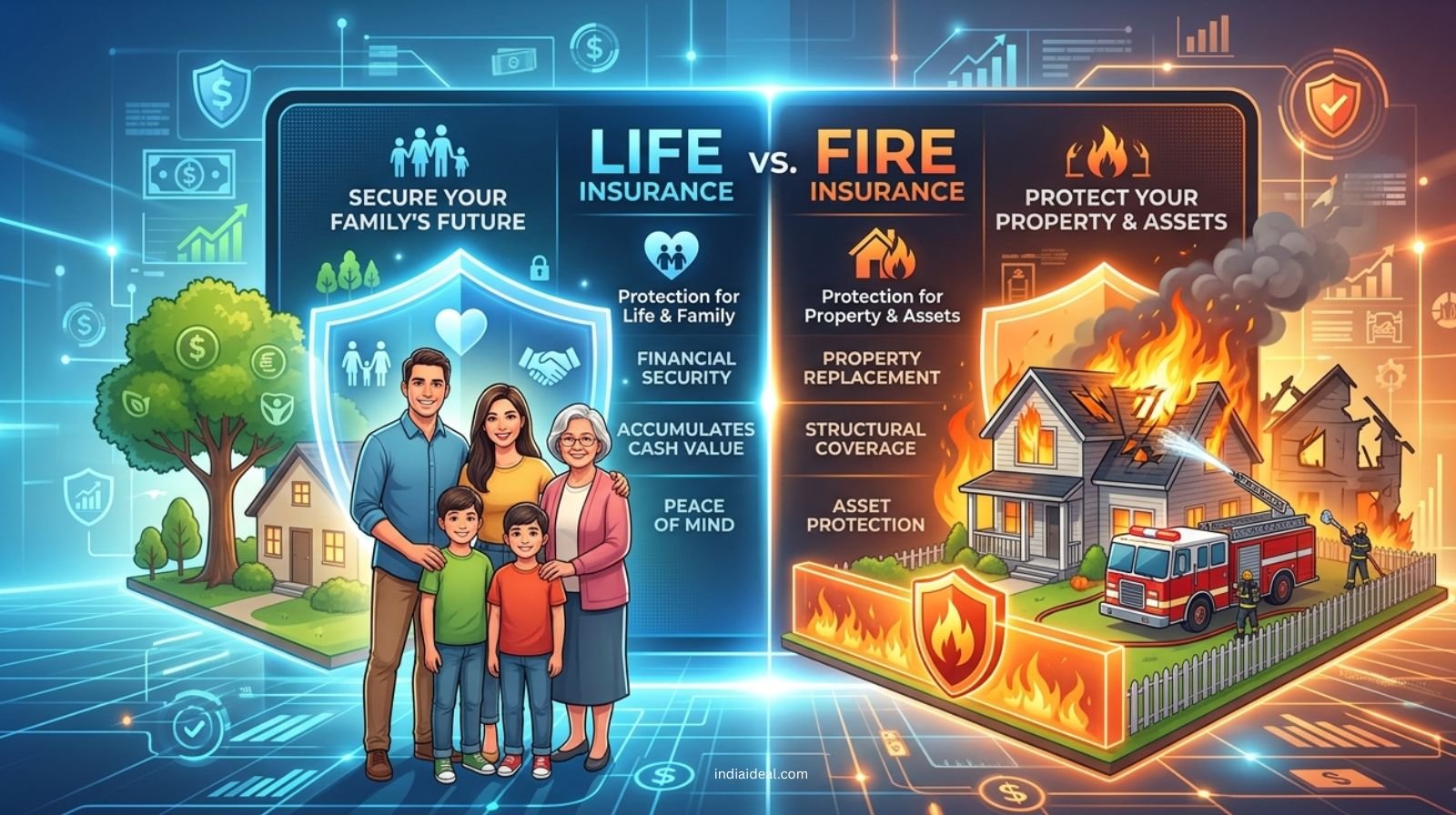
In the unpredictable journey of life, uncertainty is the only constant. Whether we are building a home or building a legacy, we are constantly managing risks. This is where Insurance steps in—not as a magic wand to stop bad things from happening, but as a financial cushion to soften the blow when they do.
However, not all insurance policies are create equal. Two of the most fundamental pillars of financial planning are Life Insurance and Fire Insurance. While both offer a sense of security, they operate on completely different principles, serve distinct purposes, and offer vastly different payouts.
If you’ve ever wondered why you need both, or how they differ in the “fine print,” this deep dive will break down everything you need to know.
1. Defining the Core Concepts
Before we compare them, we must understand what they represent at their soul.
What is Life Insurance?
Life Insurance is a contract between an individual and an insurance provider where the insurer promises to pay a designated sum of money to a beneficiary upon the death of the insured person. It is fundamentally a “Contract of Guarantee.” Because death is certain (only the timing is unknown), the payout is usually guaranteed as long as premiums are paid.
What is Fire Insurance?
Fire Insurance is a type of property insurance that covers damages and losses caused by fire. It is a “Contract of Indemnity.” This means the purpose is to restore the policyholder to the same financial position they were in before the fire occurred. If no fire happens during the policy term, no money is paid out.
2. The Fundamental Nature of the Contract
The “why” behind these policies dictates how they are legally structured.
-
Contract of Guarantee vs. Indemnity: * Life Insurance is an investment and a protection tool. You cannot put a price on a human life, so the company agrees to pay a fixed Sum Assured.
-
Fire Insurance strictly follows the principle of Indemnity. You cannot profit from a fire. The insurance company will only pay for the actual value of the loss or the insured amount, whichever is lower.
-
-
The Element of Certainty: * In Life Insurance, the event (death) is certain. Therefore, the claim will eventually be paid (except in specific cases like policy lapse or “Term” insurance where the person outlives the policy).
-
In Fire Insurance, the event is uncertain. A fire may never break out, in which case the premium paid is simply the price of “peace of mind.”
-
3. Insurable Interest: When Must It Exist?
Insurable Interest is a legal requirement stating that you must suffer a financial loss if the insured item or person is harmed.
-
In Life Insurance: You must have an Insurable Interest in the person’s life at the time the policy is taken out. For example, a wife has an interest in her husband’s life. Interestingly, if they later divorce, the policy usually remains valid because the interest existed at the inception.
-
In Fire Insurance: The Insurable Interest must exist both at the time of taking the policy and at the time of the loss. If you sell your house today and it burns down tomorrow, you cannot claim the insurance because you no longer own the interest in that property.
4. Duration and Continuity
How long do these relationships last?
Life Insurance (Long-Term)
These policies are generally long-term, spanning 10, 20, or even 50 years. Some (Whole Life) cover you until you are 100. As long as you pay your Life Insurance Premium, the company cannot cancel your coverage.
Fire Insurance (Short-Term)
Fire policies are typically issue for one year. They must be renew annually. The insurer has the right to refuse renewal if the risk (like a dilapidated building or hazardous storage) becomes too high.
5. Risk Assessment and Premium Factors
The way an actuary calculates your cost differs wildly between these two types of coverage.
Life Insurance Factors:
-
Age: Younger applicants pay significantly lower premiums.
-
Health History: Pre-existing conditions or lifestyle choices like smoking increase the cost.
-
Occupation: A professional skydiver will pay more than an accountant.
Fire Insurance Factors:
-
Location: Proximity to a fire station or high-risk industrial zones.
-
Construction Material: A wooden cabin costs more to insure than a concrete villa.
-
Usage: A residential home is cheaper to insure than a chemical warehouse or a restaurant kitchen.
6. Payout Scenarios: Who Gets the Money?
-
Life Insurance: The payout (Death Benefit) goes to the Nominee or Beneficiary. It provides a safety net for the family to pay off debts, fund education, or cover daily living expenses.
-
Fire Insurance: The payout goes to the Policyholder (the owner of the property). The money is intend to repair the structure, replace destroyed inventory, or rebuild the home.
7. Surrender Value and Savings Element
This is perhaps the biggest “financial” difference for the consumer.
Life Insurance (specifically Endowment or Whole Life plans) often accumulates a Surrender Value. If you decide to stop the policy after a few years, you get a portion of your money back. It acts as a Saving Instrument.
Fire Insurance has zero surrender value. If the year passes and no fire occurs, the premium is considered “consumed.” It is a pure expense for protection, much like car insurance.
Comparison Table: At a Glance
| Feature | Life Insurance | Fire Insurance |
| Object of Insurance | Human Life | Physical Assets/Property |
| Type of Contract | Guarantee/Certainty | Indemnity/Contingent |
| Policy Term | Long-term (5 to 30+ years) | Short-term (Usually 1 year) |
| Claim Trigger | Death or Maturity | Damage by Fire |
| Premium Refund | Possible (if it’s a savings plan) | Never refunded |
| Insurable Interest | Required at inception | Required at inception & loss |
The Concept of “Moral Hazard”
In both types of insurance, companies look out for Moral Hazard.
In Life Insurance, this refers to providing false health information or engaging in extreme risks. Fire Insurance, insurers are very wary of “Arson”—cases where a business owner might intentionally set fire to their failing business to collect the insurance money. Because fire insurance is a Contract of Indemnity, the investigators will look closely to ensure the payout does not exceed the actual loss.
Why You Need Both for a Robust Financial Plan
It isn’t a matter of choosing one over the other. They protect different halves of your life’s work.
-
Protecting Your Income: Life Insurance ensures that if the “breadwinner” is no longer there, the family’s lifestyle doesn’t collapse.
-
Protecting Your Assets: Fire Insurance ensures that if your physical wealth (your home or business) turns to ash, you have the capital to start over without losing your life savings.
Financial Security is built on layers. Your life insurance is the foundation for your family, while fire insurance is the roof over your physical assets.
Final Thoughts: Choosing the Right Policy
When looking for Insurance Coverage, remember that the cheapest policy isn’t always the best.
For Life Insurance, look at the Claim Settlement Ratio of the company. You want to be sure they actually pay out when the time comes.
For Fire Insurance, read the inclusions carefully. Does it cover “Bushfires”? Does it cover “Electrical short-circuits”? Understanding these nuances is the difference between being fully protected and being left with a stack of unpaid bills.
Risk Management is about being proactive. By understanding the differences between these two vital contracts, you are better equip to protect your family, your home, and your future. Don’t wait for the “unthinkable” to happen—the best time to insure was yesterday; the second best time is today.
