
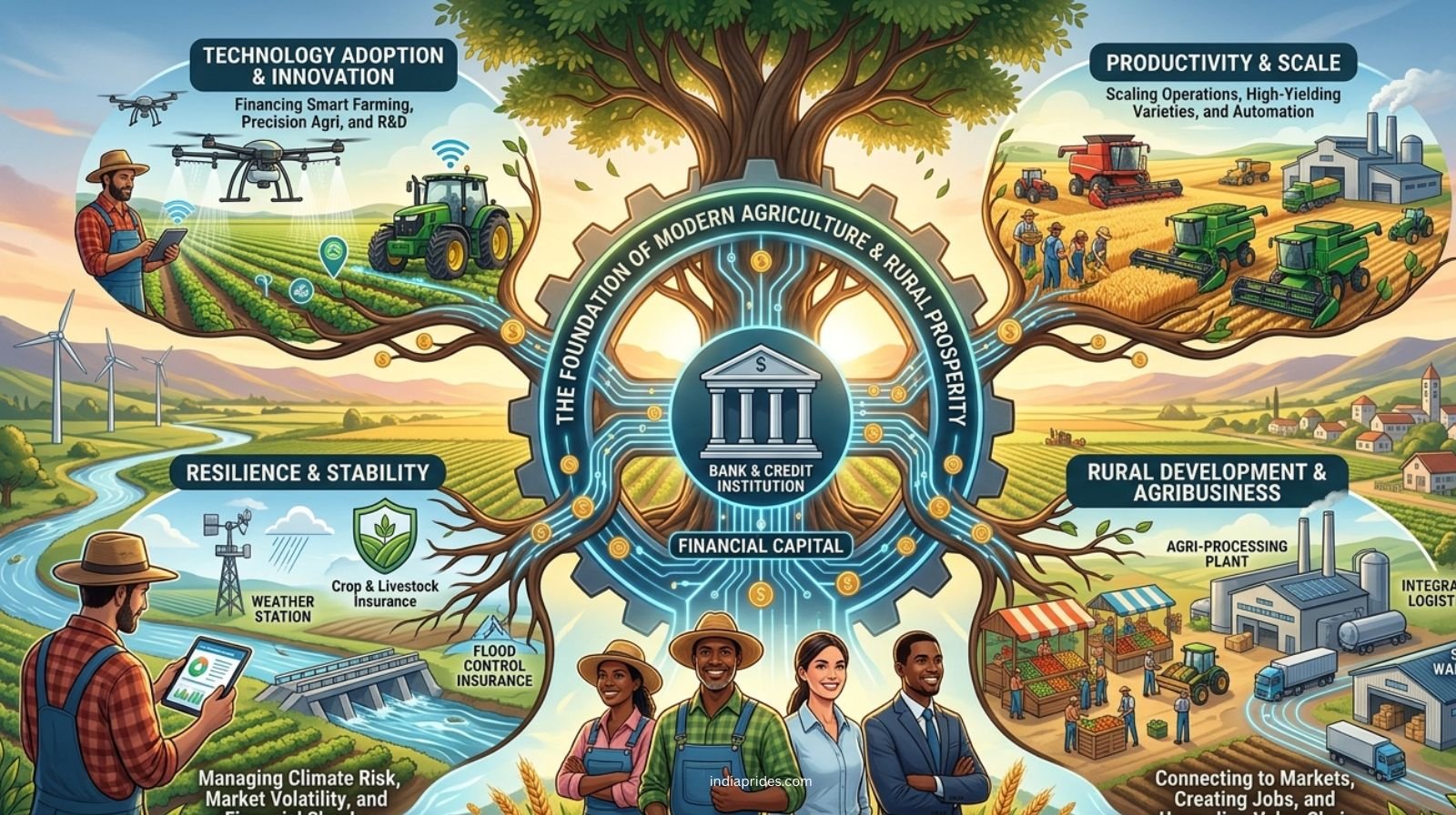
In the modern economic landscape of 2026, the soil is no longer just a source of food; it is a sophisticated engine of global stability. At the center of this engine lies agricultural finance. Without it, the world’s most vital industry would grind to a halt.
For years, farming was seen as a traditional, labor-intensive craft. Today, it is a high-tech, data-driven enterprise. From AI-driven risk modeling to satellite-powered credit assessment, the way we fund our fields has evolved.
But why does this matter to you? Whether you are a farmer, an investor, or a consumer, the flow of agri-credit determines the price of your bread and the health of our planet.
1. Bridging the Gap: Transforming Small Farms into Powerhouses
Most of the world’s food is grown by small-scale farmers. However, these producers often face a “credit gap.” Agricultural finance acts as a bridge, allowing these farmers to move from subsistence to surplus.
- Financial Inclusion: It brings unbanked rural populations into the formal economy.
- Scaling Operations: Access to short-term crop loans allows farmers to buy high-quality seeds and fertilizers.
- Income Stability: By providing liquidity, finance prevents farmers from selling their harvest at “distress prices” immediately after the season.
2. Fueling the Technological Revolution in the Fields
We are in the era of “Ag-Tech.” But drones, autonomous tractors, and smart irrigation systems aren’t cheap. Agri finance companies are the silent partners in this technological leap.
- Precision Agriculture: Financing allows for the adoption of sensors that reduce water and pesticide use by 30% or more.
- Mechanization: Loans for combine harvesters and solar-powered cold storage reduce manual labor and post-harvest losses.
- Data-Driven Decisions: Modern farm management software is often bundled with financial products, helping farmers optimize their ROI.
3. The Shield Against Climate Uncertainty
The weather is no longer predictable. In 2026, climate-resilient agriculture is a necessity, not a choice. Agricultural finance provides the safety net needed to survive a changing environment.
- Crop Insurance: Many modern loans are bundled with weather-indexed insurance, protecting farmers from droughts or floods.
- Sustainable Practices: Green finance initiatives offer lower interest rates to farmers who adopt regenerative farming or carbon sequestration methods.
- Resilience Building: Capital allows for the construction of greenhouses and advanced drainage systems that mitigate climate risks.
4. Strengthening Global Food Security
As the global population nears 8.3 billion, the pressure to produce is immense. Agricultural finance is the primary tool for ensuring food security.
- Boosting Productivity: Increased investment directly correlates with higher yields per hectare.
- Supply Chain Stability: Funding for warehouse receipt financing ensures that food is stored properly and released to the market steadily, preventing price spikes.
- Reducing Wastage: Better processing and transport equipment—funded by agri-term loans—mean more food reaches the table and less rots in the field.
5. Driving Macroeconomic Growth
Agriculture is the backbone of many developing and emerging economies. When the farm sector thrives, the entire nation prospers.
- National Income: Agriculture contributes significantly to the GDP, and agri-credit is the catalyst for that contribution.
- Foreign Exchange: Export-oriented farming generates vital foreign currency, which is then used to fund infrastructure and education.
- Employment: By supporting allied sectors like poultry, dairy, and pisciculture, finance creates millions of rural jobs.
6. Empowering Women in Agriculture
In 2026, the role of women in the fields has reached a historic high. However, access to land and capital remains a hurdle. Specialized micro-finance and collateral-free agricultural loans are changing this narrative.
- Gender Parity: Targeted financial products empower women to own assets and make independent management decisions.
- Social Impact: When women control agricultural income, it is more likely to be spent on children’s education and nutrition.
- Inclusive Growth: Programs like the Kisan Credit Card (KCC) saturation mission are specifically focusing on reaching women farmers to close the inclusion gap.
7. The Role of Innovative Financial Products
The “one-size-fits-all” loan is dead. Today’s market offers diverse types of agricultural finance tailored to specific needs:
| Loan Type | Primary Purpose | Key Benefit in 2026 |
| Kisan Credit Card (KCC) | Working Capital | Effective interest rates as low as 4%. |
| Warehouse Receipt Finance | Post-harvest liquidity | Avoids “distress selling” by using crops as collateral. |
| Solar Financing | Renewable Energy | Reduces operational costs and promotes sustainability. |
| Agri-LAP (Loan Against Property) | Large-scale expansion | High-value funding for farm modernization and land purchase. |
8. Overcoming Challenges: The Digital Shift
While the importance of finance is clear, hurdles like a lack of collateral and high interest rates in the informal sector still exist. The solution in 2026 is Digital Transformation.
- Blockchain Tracking: Ensuring transparent and fast disbursal of subsidies and loans.
- API-enabled KYC: Reducing the paperwork burden for rural farmers, making loan approval almost instantaneous.
- Satellite Monitoring: Using real-time data to verify crop health, which lowers the risk for banks and lowers rates for farmers.
Conclusion: A Future Funded by Growth
Agricultural finance is far more than just “money for farmers.” It is the foundation of a sustainable, well-fed, and technologically advanced world. As we look toward the future, the integration of AI, green energy, and inclusive banking will continue to redefine what is possible in the fields.
Investing in agriculture is not just an economic decision; it is an investment in our collective survival. By supporting the financial health of our growers, we ensure the prosperity of our entire civilization.
