
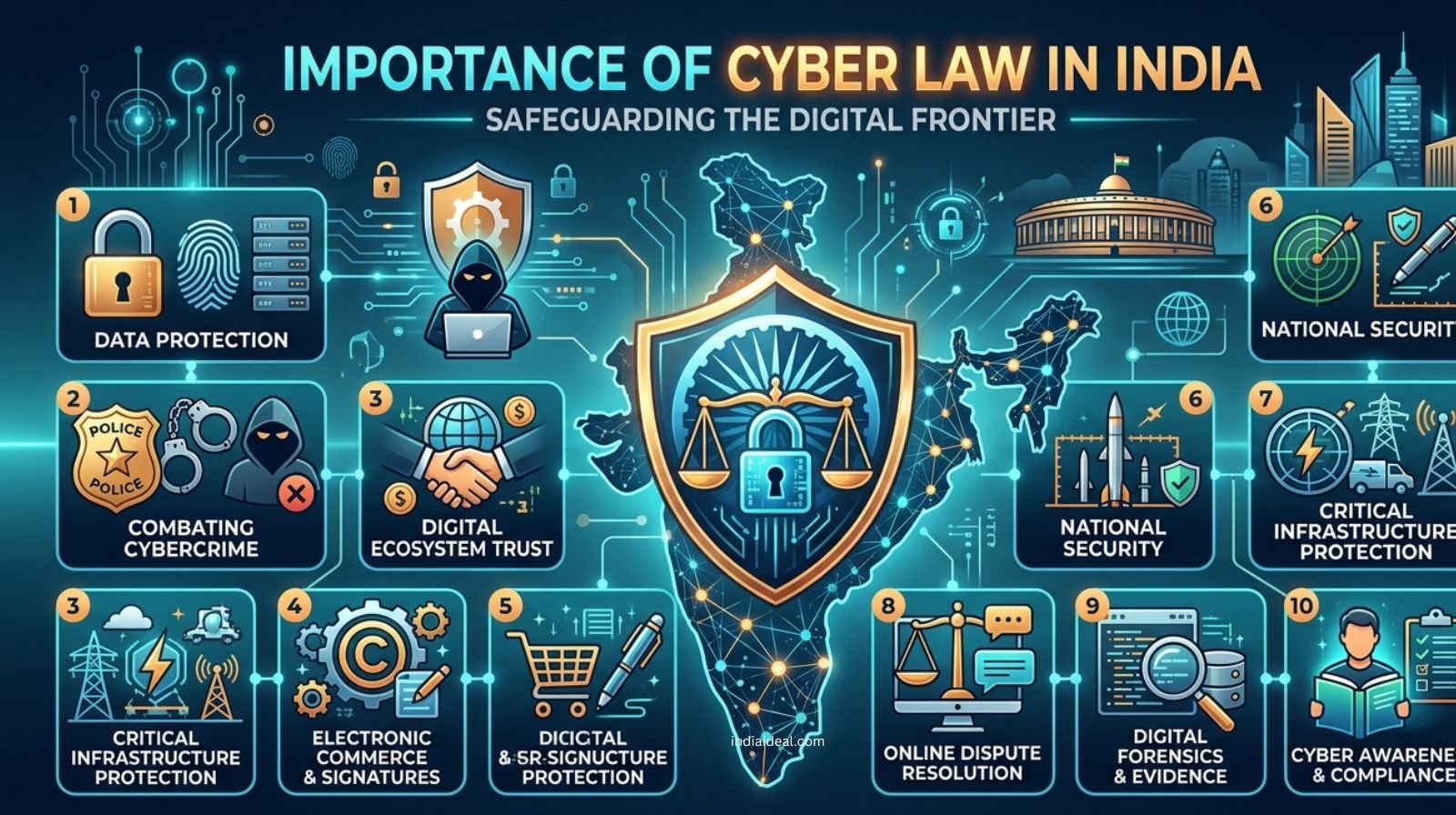
In the year 2026, India has solidified its position as a global tech powerhouse. With over a billion people connected to the internet, our lives—from UPI payments and digital health records to AI-driven workplaces—rely entirely on the “cloud.” However, this massive digital expansion has also opened the doors to sophisticated cyber threats, deepfakes, and AI-driven phishing.
This is where the legal framework steps in. Understanding the Top 10 importance of cyber law in India is no longer just for lawyers or IT professionals; it is a survival skill for every citizen and business owner in the digital age.
Here is why cyber law is the backbone of India’s Digital India mission in 2026.
1. Legal Recognition of Digital Transactions
The primary Top 10 importance of cyber law in India lies in giving “paperless” actions the same weight as physical ones. Under the Information Technology Act, 2000, electronic records and digital signatures are legally valid.
-
E-Commerce Growth: It allows businesses to execute multi-crore contracts digitally without needing physical presence.
-
Banking Trust: Every time you use a digital wallet or net banking, you are protected by a legal framework that recognizes that transaction as a binding agreement.
2. Protection Against Identity Theft and Financial Fraud
With the rise of AI-generated deepfakes and credential harvesting in 2026, identity theft has become a major concern. Cyber laws provide a direct mechanism to penalize those who impersonate others online.
-
Section 66C & 66D: These sections of the IT Act specifically target identity theft and cheating by personation using computer resources.
-
Punitive Measures: Knowing that there are strict imprisonment terms and heavy fines acts as a significant deterrent for cyber criminals.
3. Safeguarding Personal Data and Privacy (DPDP Act)
In 2026, the Digital Personal Data Protection (DPDP) Act has become a cornerstone of Indian law. One of the Top 10 importance of cyber law in India is ensuring that your personal information isn’t sold or misused by “Data Fiduciaries.”
-
Consent Framework: Companies must now get explicit consent before collecting your data.
-
Right to Erasure: Users have the legal right to ask a company to delete their data, ensuring “The Right to be Forgotten.”
4. Deterrence of Cyber Terrorism
National security is intrinsically linked to the digital space. Cyber laws provide the government with the power to act against those threatening the sovereignty and integrity of India.
-
Section 66F: This section deals with cyber terrorism, carrying a maximum penalty of life imprisonment.
-
Critical Infrastructure: It protects our power grids, nuclear plants, and communication satellites from foreign state-sponsored hacks.
5. Regulation of Social Media and Intermediaries
In an era of viral misinformation and “fake news,” the Top 10 importance of cyber law in India includes holding social media giants accountable.
-
Intermediary Guidelines: Platforms like X (formerly Twitter), Meta, and WhatsApp must have a grievance redressal mechanism.
-
Content Removal: Laws empower authorities to order the removal of obscene, defamatory, or religiously sensitive content that could incite violence.
6. Facilitating E-Governance and Digital Services
The “Digital India” dream relies on the seamless delivery of government services. Cyber laws ensure that filing taxes, applying for a passport, or accessing DigiLocker is secure and legally backed.
-
Transparency: It mandates how government departments store and handle citizen data.
-
Efficiency: By legalizing digital filings, the government has reduced red tape and improved the speed of service delivery.
7. Protection of Intellectual Property (IP) Online
For the creative and software industry, the Top 10 importance of cyber law in India is about protecting digital assets.
-
Copyright & Patents: It prevents software piracy, illegal music downloads, and the unauthorized distribution of digital movies.
-
Trademark Protection: It helps brands fight against “cybersquatting,” where bad actors register domain names similar to famous brands to trick users.
8. Investigating and Prosecuting Cyber Crimes
Traditional laws (like the IPC) were often insufficient for the digital world. Cyber laws provide the police and Cyber Cells with the specific tools needed for digital forensics.
-
Evidence Admissibility: The law defines how digital evidence (emails, logs, chat history) must be collected to be admissible in a court of law.
-
Specialized Tribunals: It allows for the creation of specialized courts to handle complex tech-related disputes quickly.
9. Encouraging Foreign Investment and Digital Trade
Global giants like Google, Amazon, and Microsoft invest in India because we have a robust legal framework.
-
Global Compliance: By aligning our laws with international standards (like UNCITRAL), India becomes a “safe” destination for data processing and IT services.
-
Business Stability: Investors look for a country where their proprietary data is protected by the rule of law.
10. Addressing Emerging Technologies (AI, IoT, and Metaverse)
As we move further into 2026, the Top 10 importance of cyber law in India extends to the regulation of Artificial Intelligence and the Internet of Things (IoT).
-
Algorithmic Accountability: Laws are being drafted to ensure that AI doesn’t discriminate or violate human rights.
-
Smart Device Security: It sets the standards for the security of smart home devices, preventing them from being turned into “spyware.”
Quick Summary: Why You Should Care
If you use a smartphone, you are part of the “Cyber Ecosystem.”
-
Cyber Law = Digital Safety: Without it, your bank account would be a sitting duck.
-
Cyber Law = Accountability: It ensures that “Big Tech” cannot act like “Big Brother.”
-
Cyber Law = Future Ready: It prepares India for the next wave of the industrial revolution.
Conclusion: Navigating the Digital Frontier
The digital world is like a vast ocean—full of opportunity but also fraught with hidden dangers. The Top 10 importance of cyber law in India serves as the “lighthouse” that guides us safely through these waters.
In 2026, being “cyber-aware” is as important as being “literate.” By respecting these laws and understanding our rights, we can ensure that India’s digital journey remains inclusive, secure, and prosperous for everyone.
