
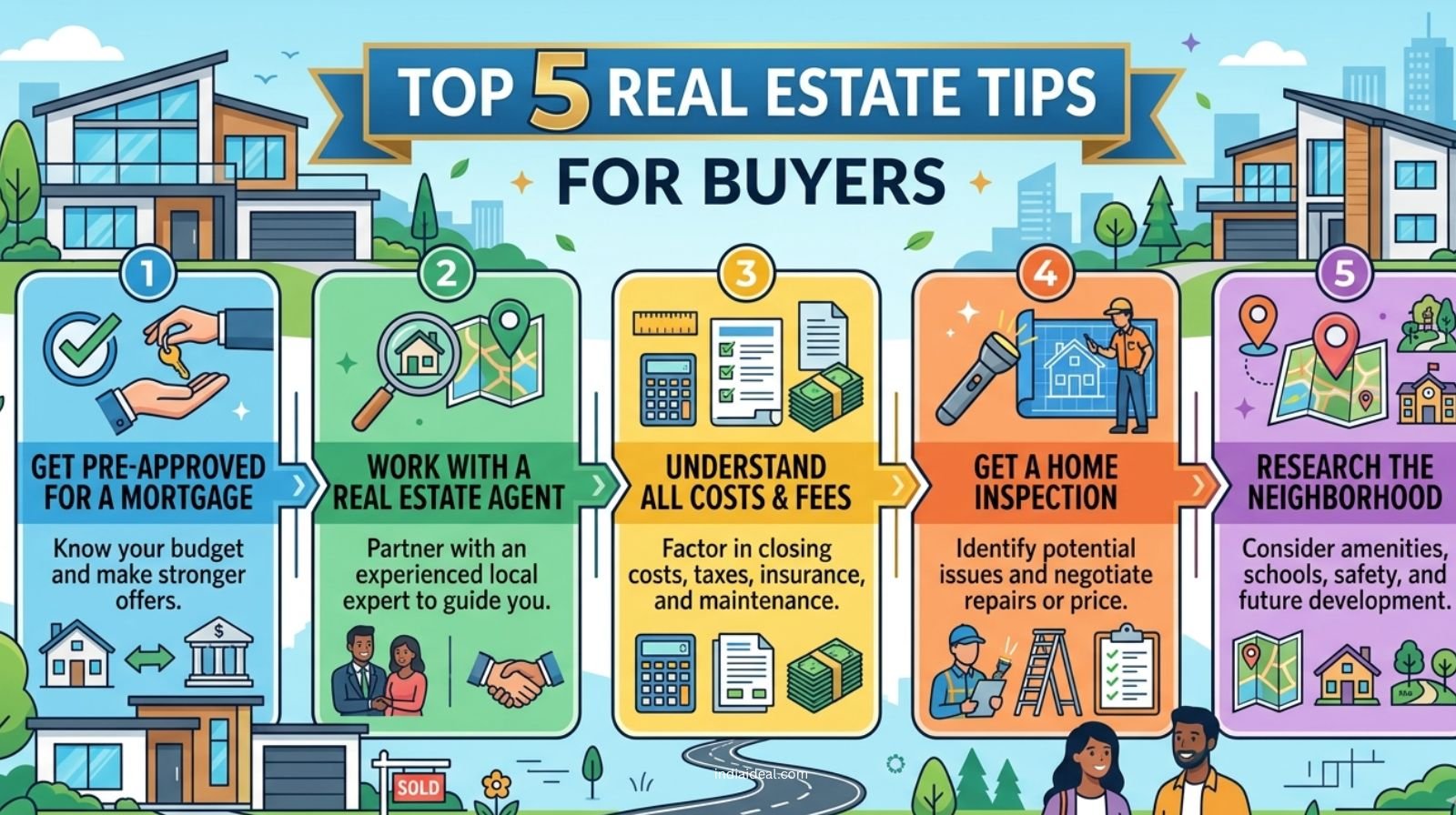
The real estate market in 2026 is no longer a simple game of “buy low, sell high.” With interest rates stabilizing and AI-powered market analytics becoming the norm, buyers are entering a landscape that rewards the strategic and punishes the impulsive. Whether you are looking for a primary residence or a high-yield investment property, the rules have changed.
To make money in real estate today, you must treat your purchase as a calculated financial maneuver. Gone are the days of “eyeballing” a neighborhood; today is about data-driven decisions and long-term equity. Here are the top 5 real estate tips for buyers to dominate the 2026 market.
1. Master the “High Intent” Location Strategy
In real estate, “Location, Location, Location” is a cliché for a reason, but in 2026, we focus on Micro-Markets. You shouldn’t just look for a good city; you should look for the specific street that is 12 months away from a major infrastructure upgrade.
-
Infrastructure Proximity: Look for areas scheduled for new metro extensions, highway interchanges, or tech hubs. These “growth corridors” offer the highest capital appreciation.
-
The 15-Minute City: Modern buyers and renters prioritize “livability.” Properties within walking distance of schools, healthcare, and co-working spaces hold their value significantly better during market dips.
-
Job Cluster Analysis: Invest where the high-paying jobs are moving. Follow the data on corporate relocations to ensure your rental demand stays at 100%.
Buying in a “settled” neighborhood is safe, but buying in an “emerging” micro-market is how you build generational wealth.
2. Leverage Pre-Approval as a Negotiation Weapon
The 2026 market moves fast. If you find a “unicorn” property—one with a perfect price-to-value ratio—you won’t be the only one bidding. To win without overpaying, you need financial leverage before you even step inside the house.
-
Get “Hard” Pre-Approved: Don’t settle for a basic pre-qualification. Get a verified pre-approval where a lender has already reviewed your tax returns and credit.
-
The 750 Credit Rule: Banks in 2026 are stricter. A credit score above 750 is the “golden ticket” to lower interest rates, which can save you $50,000+ over the life of a 30-year mortgage.
-
Proof of Funds: If you are a cash buyer or have a large down payment, show your “proof of funds” early. Sellers in a steady market prefer certainty over price.
A buyer with a pre-approval letter is a “cash-equivalent” buyer in the eyes of a seller. Use this to negotiate closing costs or a lower sale price.
3. Prioritize “Ready-to-Move” vs. “Under-Construction”
Buyer psychology in 2026 has shifted toward immediate utility. While “under-construction” projects offer lower entry prices, they carry “completion risk” that can stall your ROI.
-
The GST Advantage: In many regions, Ready-to-Move (RTM) properties exempt you from certain construction taxes (like GST), instantly saving you 5-12% on the total cost.
-
What You See Is What You Get: With an RTM home, you can inspect the construction quality, the actual natural light, and the neighbor’s noise levels.
-
Immediate Rental Yield: If you are buying for investment, an RTM property allows you to start collecting rental income on Day 1, offsetting your EMI immediately.
If you do choose an under-construction project, ensure it is RERA-approved (or equivalent) and check the builder’s delivery track record over the last 5 years.
4. Conduct a “Digital-First” Due Diligence
In 2026, the most successful buyers use technology to find “hidden” problems that a physical walkthrough might miss. Real estate transparency is at an all-time high if you know where to look.
-
Check the “Digital Paper Trail”: Use government portals to verify land titles, encumbrance certificates, and property tax history. Never take a seller’s word for “clear titles.”
-
AI Valuation Tools: Use third-party AI price predictors to see if the asking price aligns with actual recent sales in that specific building, not just the general neighborhood.
-
Drone & 3D Tours: Before visiting, use high-res 3D tours to check for structural cracks or floor-plan inefficiencies. This saves you weeks of “window shopping” and keeps your focus on high-intent properties.
Due diligence isn’t just about the house; it’s about the legal safety of your investment.
5. Calculate the “True Cost” of Ownership
The biggest mistake buyers make is budgeting only for the sticker price. To actually make money in real estate, you must understand your “all-in” numbers.
-
The Hidden 10%: Always set aside an additional 10% of the property value for stamp duty, registration fees, brokerage, and legal fees.
-
Maintenance & Sinking Funds: High-end societies often have “hidden” monthly maintenance costs that can eat into your monthly cash flow.
-
The “30% Rule”: Ensure your total home loan EMI does not exceed 30–35% of your net monthly income. This “safety buffer” protects you if interest rates fluctuate.
A property is only an asset if it puts money in your pocket (or saves you rent) without causing financial stress.
The 2026 Bonus Tip: Sustainability is Value
Green is the new gold. Properties with energy-efficient ratings, solar integration, and smart water management are seeing higher resale values. In 2026, buyers are willing to pay a premium for “future-proofed” homes that have lower long-term utility costs.
Conclusion: Stop Searching, Start Strategizing
Buying a home is the largest financial decision you will ever make. To make money in the current real estate climate, you must look past the granite countertops and focus on the underlying data.
Focus on micro-market growth, secure your financing early, and never skip the legal due diligence. Real estate in 2026 rewards the patient buyer who values utility and intent over hype.
By following these 5 tips, you aren’t just buying a house—you are securing a high-performing digital-age asset.
