
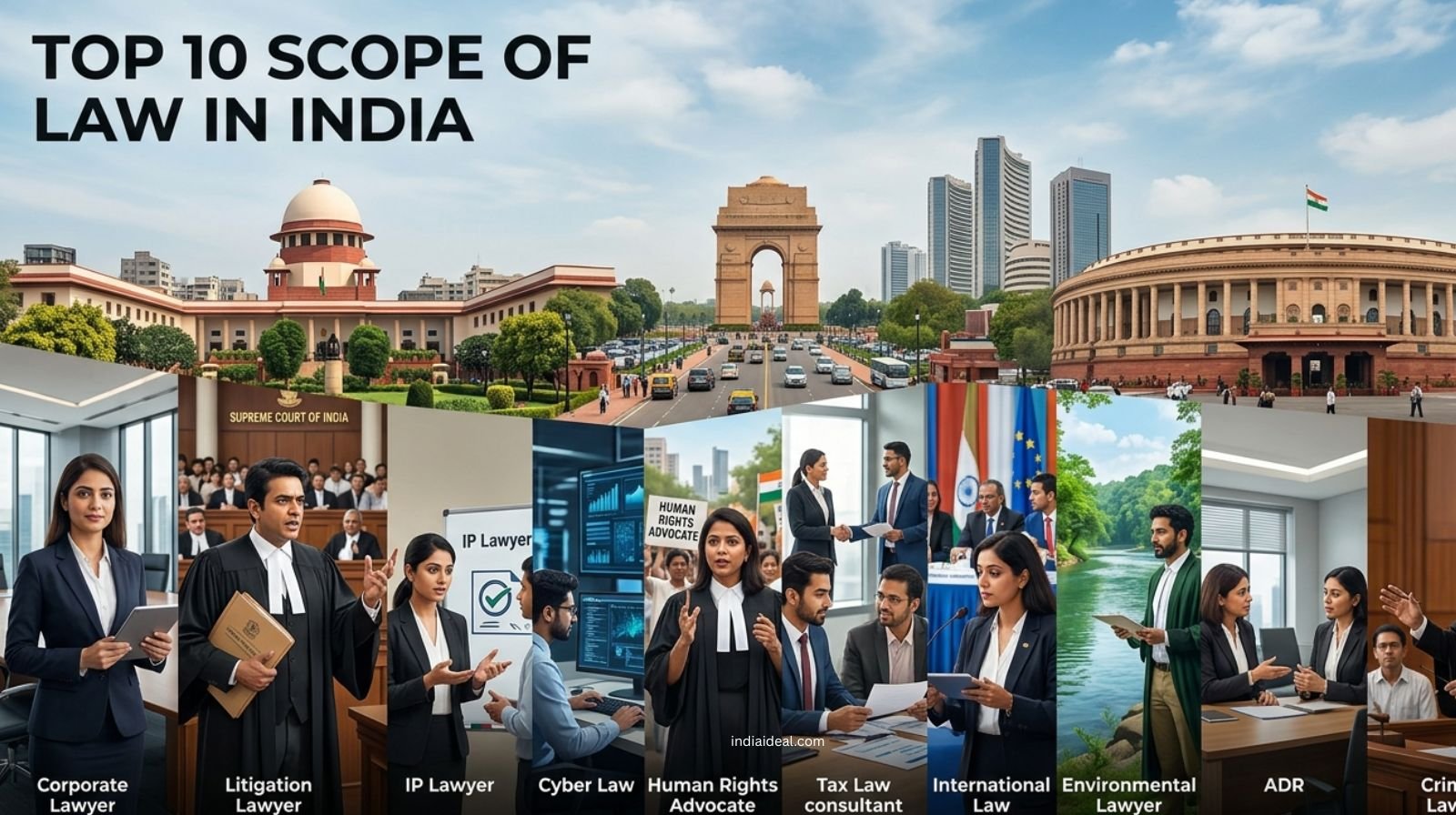
The legal landscape in India is undergoing a seismic shift. As we navigate through 2026, the image of a lawyer is no longer confined to dusty courtrooms and mountains of paperwork. Driven by digital transformation, new regulations like the Digital Personal Data Protection (DPDP) Act, and a booming economy, the “scope of law” has expanded into territories that didn’t even exist a decade ago.
Whether you are a law student, a budding advocate, or a professional looking to pivot, understanding the top 10 scope of law in India is crucial for building a future-proof career. In 2026, the law is where technology meets ethics, and where global business meets local compliance.
1. Corporate Law & Mergers and Acquisitions (M&A)
Corporate Law remains the powerhouse of the Indian legal market. As India solidifies its position as a global economic hub, companies are constantly engaging in restructuring, fundraising, and cross-border deals.
-
The 2026 Shift: With the Corporate Laws (Amendment) Bill 2026, there is a massive focus on decriminalizing minor offences and improving the “Ease of Doing Business.”
-
Career Potential: You can work as an In-house Counsel for giants like Reliance or Tata, or join Tier-1 law firms specializing in high-stakes M&A negotiations.
-
Key Skills: Mastering due diligence, contract drafting, and SEBI regulations.
2. Cyber Law & Data Privacy
In 2026, data is more valuable than oil, making Cyber Law the fastest-growing legal field in India. The full implementation of data protection regimes has created a desperate need for specialists who can navigate the intersection of technology and privacy.
-
Why it’s booming: Every mid-sized startup now requires a Data Protection Officer (DPO) to ensure compliance with Indian and international privacy laws.
-
Scope: Handling cases related to cyber-terrorism, identity theft, and data breaches.
-
Keywords: This is arguably the best career scope in law for tech-savvy graduates.
3. Intellectual Property Rights (IPR)
With the “Startup India” movement reaching its peak in 2026, protecting innovation is a top priority. IPR Law involves safeguarding the “creations of the mind”—from AI-generated art to pharmaceutical formulas.
-
Global Impact: India’s alignment with international treaties like the Madrid Protocol allows IP lawyers to manage global trademark portfolios.
-
Opportunities: Filing patents, fighting copyright infringement, and managing brand trademarks for multinational corporations.
4. Artificial Intelligence (AI) & LegalTech
By 2026, AI Law is no longer science fiction. The legal industry itself is being disrupted by LegalTech tools that automate research and drafting.
-
Emerging Roles: We now see roles like Legal Operations Consultants and AI Ethics Advisors.
-
The Advantage: Lawyers who can use AI-powered research assistants like Jhana or Vidur are delivering results 3x faster than traditional practitioners.
-
Future Scope: Developing the legal frameworks for AI liability and autonomous systems.
5. Environmental, Social, and Governance (ESG) Law
Climate change and social responsibility are now board-room priorities. ESG Law is a specialized field focusing on sustainability regulations and corporate accountability.
-
Demand: Indian companies are now mandated to provide detailed Business Responsibility and Sustainability Reports (BRSR).
-
Career Path: Advising firms on carbon credits, green finance, and environmental compliance to avoid “greenwashing” litigations.
6. Alternative Dispute Resolution (ADR)
The Indian judiciary is heavily burdened, leading to a massive push toward ADR. In 2026, Arbitration, Mediation, and Conciliation are the preferred methods for settling commercial disputes.
-
Efficiency: ADR is faster and more cost-effective than traditional litigation, making it the favorite for International Commercial Arbitration.
-
Scope: You can build a career as a certified Mediator or an Arbitrator handling multi-crore infrastructure disputes.
7. FinTech & Cryptocurrency Law
As India leads the world in digital payments (UPI), the FinTech sector requires specialized legal minds to navigate the evolving regulations of the RBI and the Ministry of Finance.
-
The Tech Edge: Understanding Blockchain, smart contracts, and the legal status of the Digital Rupee is essential.
-
Opportunities: Working with payment gateways, neo-banks, and crypto-exchanges to ensure regulatory compliance.
8. Judicial Services & Civil Services
For those who seek prestige and the power to impact society directly, the Judiciary remains a top choice. In 2026, the push for a specialized All India Judicial Service (AIJS) continues to be a hot topic.
-
The Path: Cracking the Judicial Services Exam (PCS-J) to become a Civil Judge or Magistrate.
-
Non-Legal Scope: Many law graduates also successfully clear the UPSC to become IAS or IPS officers, using their legal background to excel in administration.
9. Legal Journalism & Content Creation
The rise of digital media has created a unique niche for Legal Journalism. Public awareness of legal rights has never been higher, and people want complex laws explained in simple terms.
-
Platforms: Working for legal news portals like Bar and Bench or Live Law, or even starting an independent legal YouTube channel/podcast.
-
Value: Breaking down Supreme Court judgments for the general public and providing real-time reporting on landmark cases.
10. Maritime & Energy Law
With India’s massive coastline and the push toward Blue Economy, Maritime Law is a niche but highly lucrative field. Similarly, the transition to Green Energy (Solar/Hydrogen) requires specialized legal frameworks.
-
Maritime Scope: Handling shipping contracts, marine insurance, and international sea boundary disputes.
-
Energy Scope: Drafting power purchase agreements (PPAs) and navigating the legalities of the Green Hydrogen Mission.
How to Choose Your Niche in 2026?
Finding the right scope of law in India depends on your interests and the lifestyle you want:
-
High-Pace & High-Pay: Choose Corporate Law or M&A.
-
Tech & Innovation: Dive into Cyber Law or AI Ethics.
-
Social Impact: Focus on Human Rights or Environmental Law.
-
Stability & Power: Aim for Judicial Services.
Conclusion: The Law is Evolving—Are You?
The scope of law in India in 2026 is no longer a narrow path; it is a sprawling highway with multiple exits. The key to success in this new era is specialization. Gone are the days of the “General Practitioner.” Today’s market rewards those who master a specific niche—be it Data Privacy or ESG Compliance.
As the legal profession becomes more tech-integrated, the most successful lawyers will be those who combine legal traditionalism with technological fluency.
